
Three lines. One boundary.
DETAIL · THREE LINES · REDACTION ENGINE · INTEGRATION
General notes
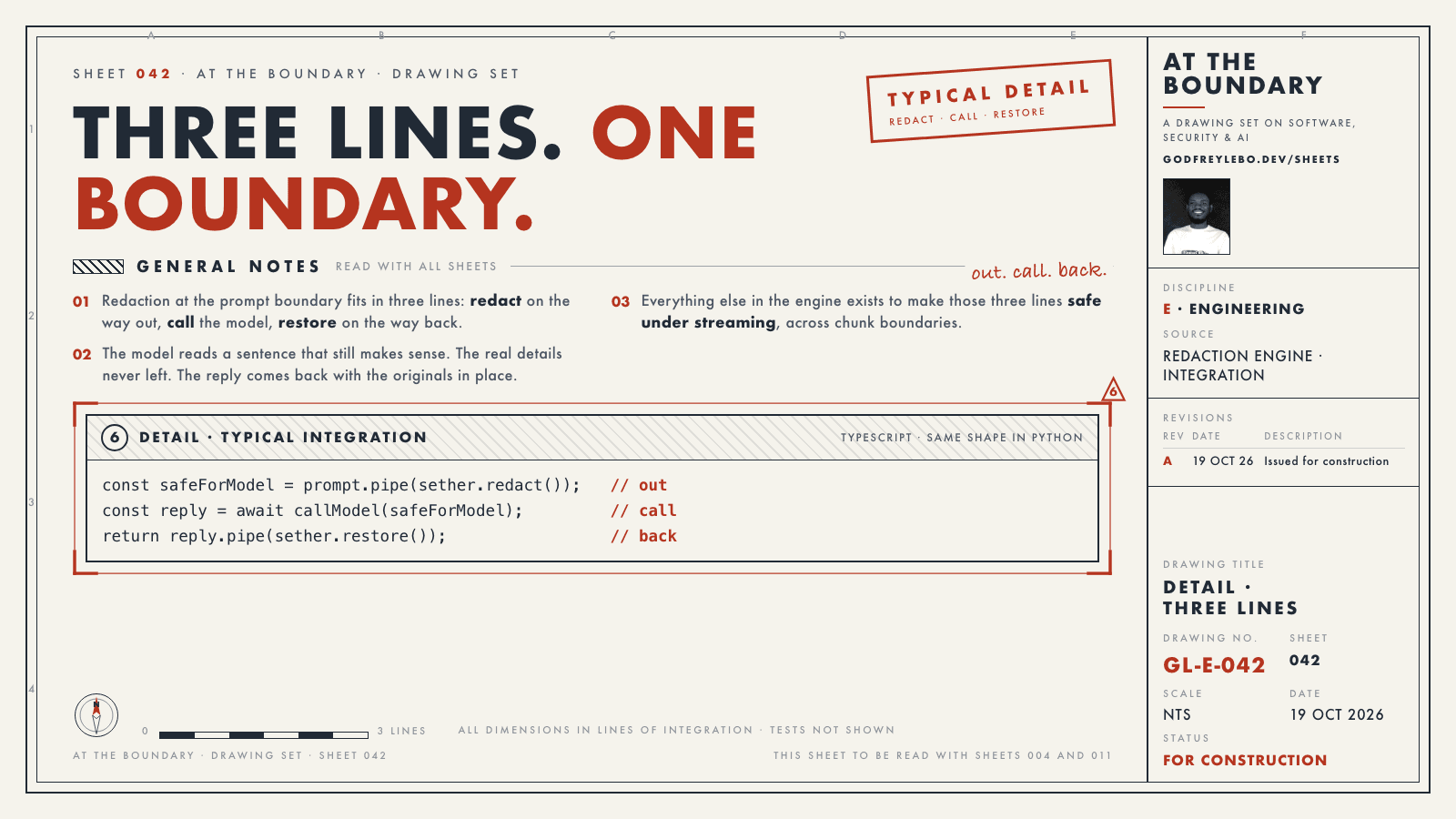
- 01Redaction at the prompt boundary fits in three lines: redact on the way out, call the model, restore on the way back.
- 02The model reads a sentence that still makes sense. The real details never left. The reply comes back with the originals in place.
- 03Everything else in the engine exists to make those three lines safe under streaming, across chunk boundaries.
out. call. back.
const safeForModel = prompt.pipe(sether.redact());   // out
const reply = await callModel(safeForModel);         // call
return reply.pipe(sether.restore());                 // back
As posted
The whole idea of redaction at the prompt boundary fits in three lines.
Redact on the way out. Call the model. Restore on the way back.
The model reads a sentence that still makes sense: a name, a phone, a card number, each swapped for a stable token or a realistic decoy before the text leaves your process. The reply comes back with the originals in place. The real details never left.
Everything else in the engine exists to make those three lines safe under streaming. A card number can arrive split across two chunks. A token can come back split across two chunks. A JSON payload has to stay valid JSON after the swap. Every regular expression has to be bounded, so one crafted input cannot hang the server. Nearly two hundred tests and a static scan sit behind three lines of integration, and that is the right ratio.
For construction. Sheet 042. The set closes tomorrow with the index.